


The Scoville Scale and Scoville Heat Unit (SHU) were named for scientist Wilbur Scoville in 1912. Here's everything you need to know - what the scale measures, how it works, and a complete list of peppers ranked from mildest to hottest, with real-world heat context for each level.
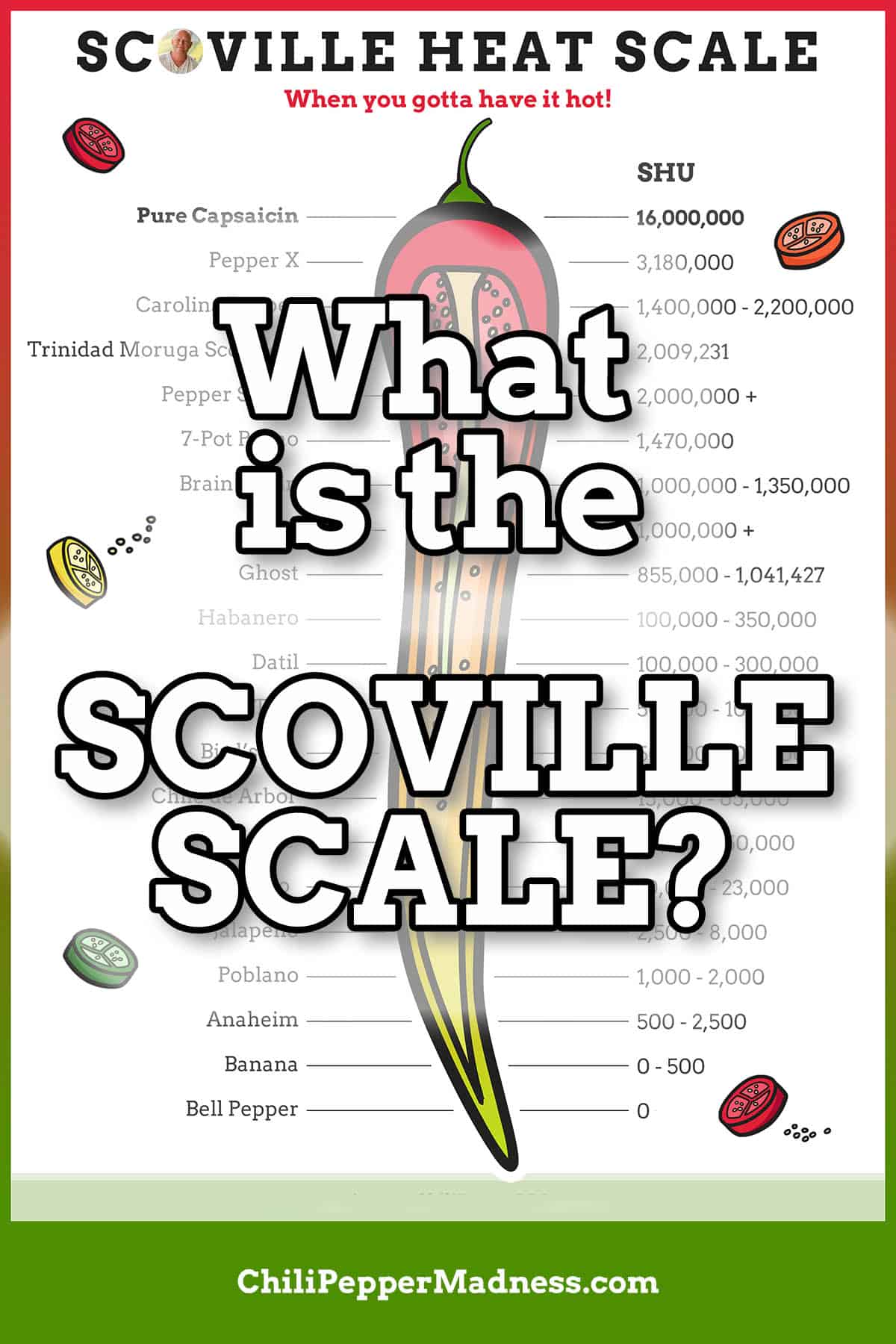
What is the Scoville Scale?
I've been cooking with chili peppers for over 30 years, and the question I get most often is some version of "how hot is that?" The Scoville Scale is how we answer it.
The Scoville Scale was named for scientist Wilbur Scoville, who developed it in 1912 while working for pharmaceutical company Parke-Davis. He created what he called the "Scoville Organoleptic Test". He ground up peppers, mixed them with sugar water, and had a panel of tasters sip the solutions. He'd dilute the mix bit by bit until the heat disappeared, then assign a number based on how many dilutions it took.
Those measurements run in multiples of 100. Note that 1 part per 1,000,000 dilutions of water is rated at 1.5 Scoville Units.
Pure capsaicin, the compound responsible for pepper heat, sits at 16,000,000 SHU. That's the ceiling, and it puts everything else in perspective.
Current Scoville Scale Measurements
Today, we don't rely on human tasters. Heat is measured using High Performance Liquid Chromatography (HPLC), which detects and quantifies the capsaicin concentration directly and reports results in ASTA pungency units. It's more precise and considerably less painful.
What's really being measured is capsaicin, the active compound in the genus Capsicum that produces that burning sensation on your tongue and lips. Peppers contain capsaicin alongside other capsaicinoids, and the ratio between them shapes the unique heat profile of each variety.
The Scoville Scale applies to anything made from chili peppers, not just the peppers themselves, which is why you'll see hot sauces and pepper sprays listed alongside fresh peppers.
What is really being measured is the concentration of "capsaicin", the active ingredient that produces that sensation of heat on our tongues. The term "capsaicin" comes from the pepper plants' classification, of the genus Capsicum.
Capsaicin occurs naturally in peppers along with other capsaiciniods, all of which make up the unique tastes and heat reactions of each pepper, depending on their ratios.
A Complete List of Chili Peppers and Hot Sauces Ranked by Scoville Heat Unit
Here is a list of Scoville Heat Units (SHU) of the most common chili peppers and hot sauces so you can get an understanding of how they relate to each other.
This isn't an exhaustive list. There are hundreds of pepper varieties, but it covers the most common peppers and hot sauces so you can see how they relate to each other. I've added real-world heat context at each level so the numbers actually mean something.
[MILD - 0 to 1,000 SHU] At this range, you're essentially feeling no heat at all. These are everyday cooking peppers. Even people who can't handle any spice can eat freely in this range.
- Bell Pepper - 0 SHU
- Banana Peppers - 0 - 500 SHU
- Shishito Peppers - 50 - 200 SHU
- Pepperoncini Peppers - 100 - 500 SHU
- Cholula Hot Sauce - 500 - 1,000 SHU
[MILD-MEDIUM - 1,000 to 5,000 SHU] You start to notice a gentle warmth here, especially in the upper range. Nothing that lingers or builds. Great entry-level heat for people just getting into spicy food.
- Anaheim Peppers - 500 - 2,500 SHU
- Texas Pete Hot Sauce - 747 SHU
- Valentina Hot Sauce (Red Label) - 900 SHU
- Poblano Peppers - 1,000 - 2,000 SHU
- Ancho Peppers (Dried Peppers) - 1,000 - 2,000 SHU
- Hungarian Wax Peppers - 1,000 - 15,000 SHU
- Valentina Hot Sauce - 2,200 SHU
- Crystal Hot Sauce - 2,000 - 4,000 SHU
- Espelette Peppers - up to 4,000 SHU
- Tabasco Hot Sauce - 2,000 - 5,000 SHU
- Huy Fong Sriracha Hot Sauce - 2,200 SHU
[MEDIUM - 2,500 to 15,000 SHU] Jalapeño territory. This is where most people start to feel real heat, a noticeable tingle, some warmth that builds with each bite. Most people can handle this range with no problem, though it depends on tolerance. This is the baseline I use when developing recipes for general audiences.
- Guajillo Peppers - 2,500 - 5,000 SHU
- Tapatio Hot Sauce - 3,000 SHU
- Jalapeno Peppers - 2,500 - 8,000 SHU
- Chipotle Peppers - 2,500 - 8,000 SHU
- Tabasco Habanero Hot Sauce - 7,000+ SHU
- Aleppo Pepper - 10,000 SHU
[MEDIUM-HOT - 10,000 to 100,000 SHU] Now we're into serious heat territory. A serrano hits noticeably harder than a jalapeño. By the time you get to cayenne and Thai peppers, you'll feel a real burn that lingers. This is where I start recommending caution with raw peppers if you're not experienced.
- Serrano Peppers - 10,000 - 23,000 SHU
- Calabrian Peppers - 25,000 - 40,000 SHU
- Chile de Arbol Peppers - 15,000 - 65,000 SHU
- Cayenne Peppers - 30,000 - 50,000 SHU
- Aji Amarillo Peppers - 30,000 - 50,000 SHU
- Chiltepin Peppers - 50,000 - 100,000 SHU
- Bird's Eye Peppers - 50,000 - 100,000 SHU
- Thai Pepper - 50,000 - 100,000 SHU
[HOT - 100,000 to 500,000 SHU] Habanero country. This is a different class of burn. It builds quickly, hits your whole mouth, and lingers for several minutes. The flavor is fruity and complex, but the heat is real. I use these regularly in my cooking, but with respect. Wear gloves when cutting them.
- Datil Peppers - 100,000 - 300,000 SHU
- Devil's Tongue Peppers - 125,000 - 325,000 SHU
- African Bird's Eye - 175,000 SHU
- Habanero Peppers - 100,000 - 350,000 SHU
- Scotch Bonnet Peppers - 100,000 - 350,000 SHU
[SUPERHOT - 1,000,000+ SHU] Above 1 million SHU, you're in territory most people will never encounter in food, and probably shouldn't unless you really know what you're doing. The burn is immediate and intense, spreads across your face and throat, and can last 20-45 minutes. I've eaten ghost peppers and scorpions straight. I don't recommend it casually, but they're incredible in controlled amounts when cooked into sauces or dishes. A little goes a very, very long way.
- Ghost Peppers - 1,000,000 + SHU
- Trinidad Scorpion Butch T Pepper - 800,000 – 1,463,700 SHU
- 7-Pot Chili Pepper - 1 Million SHU +
- Brain Strain Peppers - 1 Million - 1.25 Million SHU
- 7-Pot Primo - 1.47 Million SHU
- Komodo Dragon Peppers - 1.4 Million - 2.2 Million SHU
- Trinidad Moruga Scorpion Pepper - 2,009,231 SHU
- Carolina Reaper Chili Pepper - 2.2 Million + SHU
- Pepper Spray - 2 Million SHU or stronger
- Dragon's Breath Pepper - 2.48 Million SHU
- Pepper X - 2,693,000 + SHU
- Apollo Pepper - 2,500,000 - 3,000,000 SHU
- Pure Capsaicin - 16 Million SHU
For a more complete list of chili peppers, visit the following links...
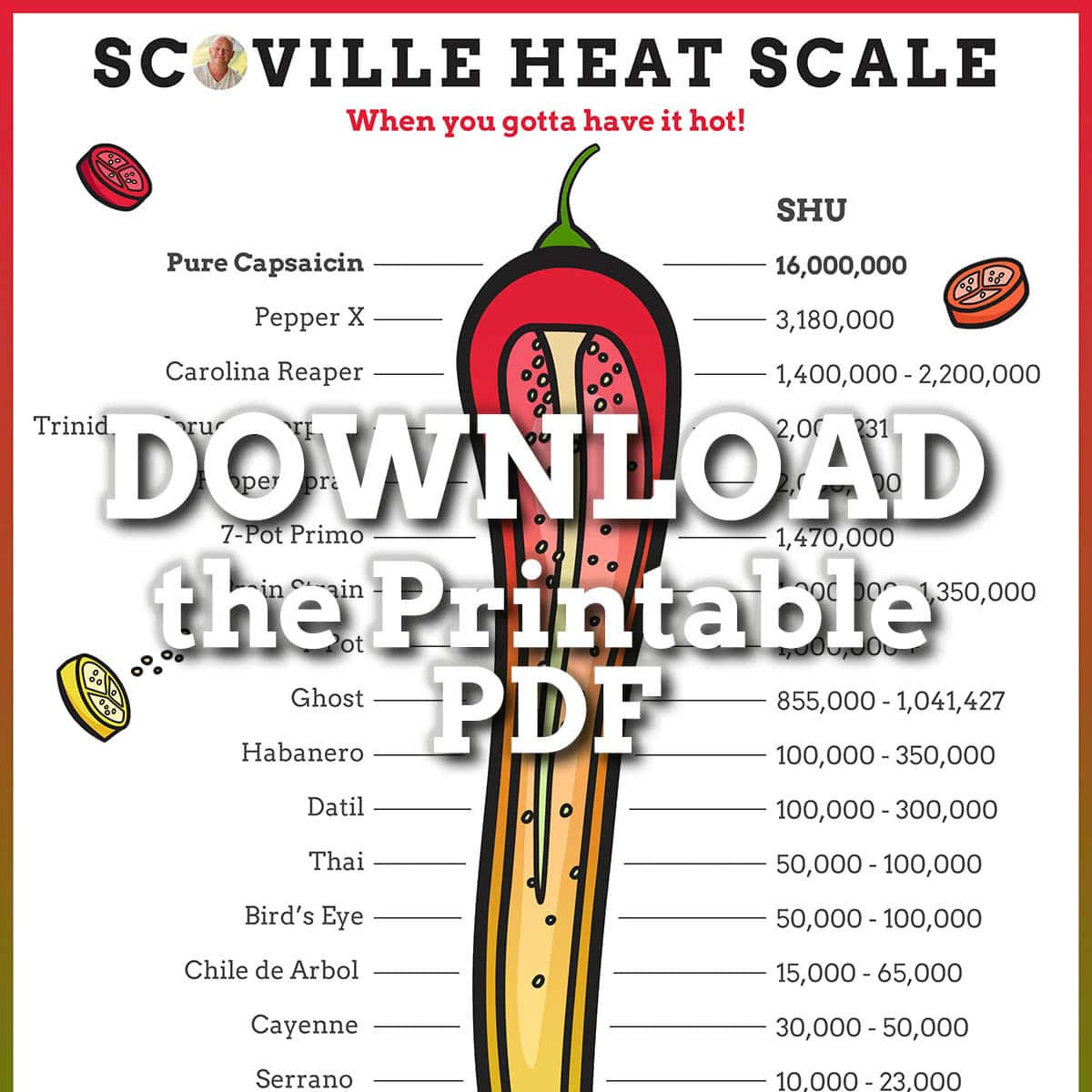
Download the Printable Scoville Scale Poster
Would you like to download a hi-resolution, print-quality PDF of the Scoville Scale? Sign up for Grow below.
Recent Updates to the Scoville Scale (2023-2025)
The race for the world's hottest pepper has been moving fast over the past few years, so here's where things stand:
Pepper X takes the crown (October 2023). Guinness World Records officially named Pepper X the world's hottest pepper, with an average heat of 2,693,000 SHU. It was created by Ed Currie, the same grower behind the Carolina Reaper, which had held the title since 2013. Pepper X has a delayed burn that hits slower and lasts longer than most superhots.
The Apollo Pepper. The Apollo, a cross between a Carolina Reaper and a Pepper X, has been circulating among growers and is being cited at 2.5-3 million SHU, though it hasn't been officially certified as of this writing. Worth watching.
The science is improving. HPLC testing has become more standardized, which means older records from the early 2010s are being revisited with more precise measurements. Some listed SHU figures may shift slightly as testing methods continue to improve.
I'll keep updating this page as new contenders emerge. If you want a deep dive into the superhot side of the scale, check out my complete list of the hottest peppers in the world.
A Recent History of Hot Peppers - Hottest Peppers in the World - News and the Scoville Scale
The Red Savina Habanero Pepper was the original "hottest pepper in the world", with a heat range of up to 580,000 Scoville Heat Units, but newer, hotter chili peppers came fast and hard in the last 20 years.
Collectively called "superhot chili peppers", these are peppers that top the 1 Million Scoville Heat Unit range, and I have some of them listed below. You can also review this link of Super Hot Chili Peppers List or my collection of Superhot Chili Peppers.
The list of the hottest chili peppers in the world is growing all the time.
Growers are producing hotter and hotter hybrids with hopes of pushing the Scoville Scale limits. 2017 saw a flurry of news articles with potential new “hottest pepper in the world” claims, including the “Dragon’s Breath Pepper” and the ultra blazing “Pepper X“, which was declared the hottest pepper in the world in October 2023, ousting the “Carolina Reaper”.
Want More Chili Pepper Heat Information?
Check Out Our List of Chili Peppers Organized by Heat Levels, from Mild to Superhot
Frequently Asked Questions About the Scoville Scale
A Scoville Heat Unit (SHU) measures the concentration of capsaicin and related capsaicinoids in a chili pepper or pepper-based product. Originally, it represented the dilution factor needed to eliminate detectable heat. Today it's calculated from HPLC chemical analysis. The higher the SHU, the more capsaicin is present, and the hotter the pepper.
As of 2023, Pepper X holds the Guinness World Record as the hottest pepper at approximately 2,693,000 SHU. It was created by Ed Currie, who also bred the Carolina Reaper, which held the title for over a decade. The Apollo Pepper may challenge that record, but hasn't been officially certified yet.
Generally, anything under 5,000 SHU is considered mild. Bell peppers sit at 0 SHU with zero heat. Banana peppers, Anaheim peppers, and most sweet peppers fall in the 0-2,500 SHU range. Even most people with low heat tolerance can handle this range comfortably.
It's a useful benchmark, but there's natural variation within pepper varieties. A jalapeño grown in hot, dry conditions may hit 8,000 SHU while one from a milder climate might come in at 2,500. Soil, water stress, sunlight, and even harvest timing all affect capsaicin content. The ranges listed on the scale reflect that natural variation, which is why you'll see ranges rather than single numbers for most peppers.
Yes. HPLC testing can measure the capsaicin concentration in any food product, including hot sauces, salsas, powders, and spice blends. That's why you'll see SHU figures for commercial hot sauces like Tabasco (2,000-5,000 SHU) and Cholula (500-1,000 SHU) along with fresh peppers.
This post was updated on 4/14/26 to include new information.
Allie says
Oh boy....my Hungarian hot wax peppers are causing me stress! 1,000 - 15,000 on the Scoville is a big range! I do know that I deseeded/diced a bunch to freeze in generous tsp's and while I got my contact lenses out that night (with a little discomfort....I DID NOT get them in until 2 days later....I'm usually pretty careful (ie gloves) but not this time...lesson learned! 🙂
Question: is there a way to tell (ie size, length of time on the plant, colour etc) which will be the hotter guys??
Mike Hultquist says
Allie, unfortunately there isn't any tried and true method to tell which of these is going to be on the hotter side.
Katie says
Now that you've given this chili-head wannabe access to any hot pepper seed, what are your top 3 gotta-have superhot peppers for cooking or for hot sauces? My garden is dying to know.
Mike Hultquist says
Katie, I love them all. Each has its own character. Don't make me choose!!! Haha.